
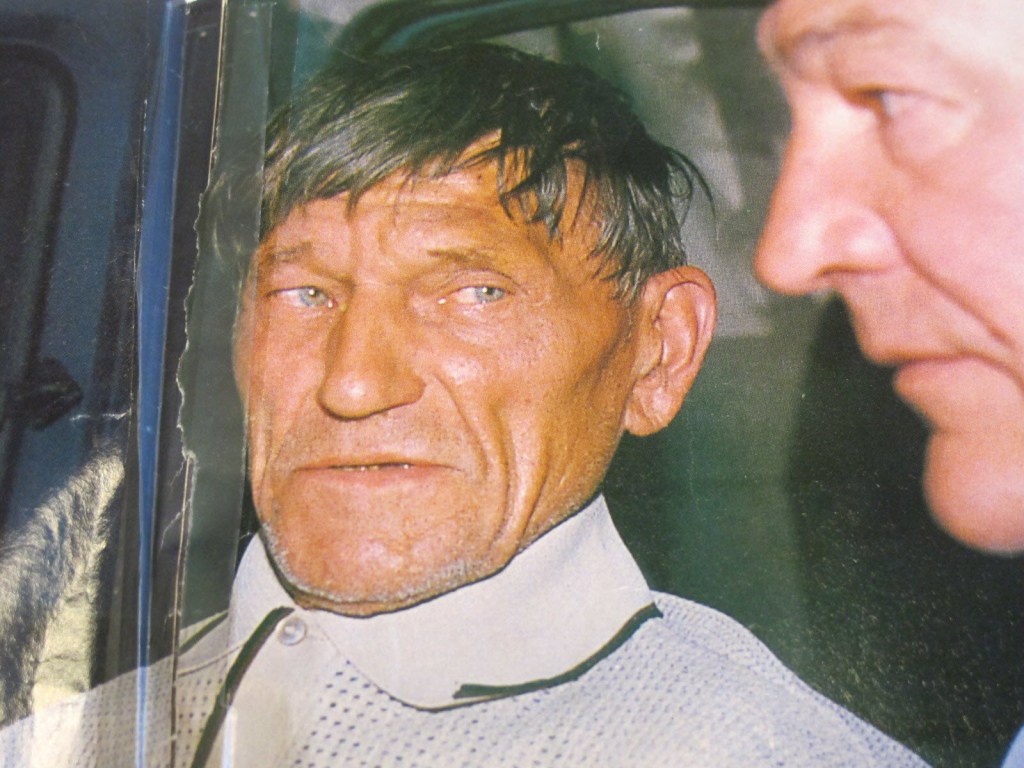
Hi everyone, I hope you’re doing well! I also hope you have a strong stomach. The crimes I’m going to talk about today are particularly violent and disgusting, and since it’s been a while since I’ve covered this type of case, you may not be used to it anymore. Today, we’re going to talk about pedophilia, domestic violence, and various injustices, so if you’re not feeling up to it, click here and go relax. If you’re ready, here’s the Michel Sydor case.
Michel is born on September 8, 1929, in Corbeil-Essonnes, much to the dismay of humanity. The timing of his birth is unfortunate, and he grows up during World War II in an unhealthy and unstable environment. Soon enough, while France is dealing with the deviance of the Nazis, those around him have to deal with his own deviance. From childhood, he takes pleasure in torturing and killing animals. He quickly becomes a delinquent outsider, who apparently dreams of a better life. In fact, he invents a life for himself as a legionnaire, to the point where it becomes his nickname. However, he never becomes a legionnaire, which is a blessing in itself. I dare not imagine this madman with an automatic weapon.
In 1950, as France is recovering from the war, he goes from petty crime to murder. After a dispute with a sex worker, Michel kills her, but is only sentenced to five years of hard labor because of his victim’s status. Yes, at that time (and still today), a woman could often be considered guilty of her own assault. Add to that the fact that despite all my research, I have not been able to find the name of this poor woman. The justice system decided she was not important enough.
After his release, Michel moves to the Pas-de-Calais region. I’m going off on a tangent here, but it seems that there is a strong connection between dangerous men and the countryside; they are often born there or move there! Perhaps they like to be left in peace to commit their atrocities…
In short, Michel earns his living doing agricultural and forestry work. Unfortunately, he finds love and marries Gilberte Boudry in 1958. The couple settles in the tiny village of Troisvaux (less than 300 inhabitants), near Béthune. Gilberte gives birth to two children, and everyone suffers Michel’s violence, unaware that he is a convicted murderer. He works as a miner’s assistant, pulling ore carts in the mines. It is exhausting work, but he still finds time to beat his wife and send inappropriate letters to young girls. Fortunately, these letters are discovered, and Michel is fired. Gilberte leaves him and returns to her parents’ home with her children. Unfortunately, Michel cannot bear what he considers to be an affront.
On the night of December 22, 1961, he goes to his in-laws’ house in Lens. Armed with a 9mm pistol, he shoots Gilberte in the head in front of her children. He also shoots her father, Henri, who survives and fires back with his hunting rifle. He manages to wound Michel, who flees. Henri calls for help, and Michel is arrested the next day. He briefly denies the crime, then confesses, claiming it was a crime of passion. Let’s talk a little about this notion of crime of passion, because this term grates on me in a very unpleasant way. To imply that you can love someone AND kill them makes no sense. Think of someone you sincerely love. If that person decided never to see you again, would your first instinct be to kill them? Exactly.
Michel is charged with murder and attempted murder and placed in pretrial detention. This time, his victim is well-regarded by society, so there is a good chance that she will obtain justice.
He continues to plead the crime of passion during his trial in June 1964. He faces the death penalty, but a crime of passion would reduce his sentence to 20 years in prison. In the end, he is sentenced to life imprisonment on June 26, 1964. At the time, life imprisonment carried a minimum sentence of 15 years, after which the convicted person could apply for parole.
In 1972, Pompidou grants him a presidential pardon, reducing his sentence to 20 years. Well, what can we expect from the man who pardoned Paul Touvier, a Nazi collaborator convicted of crimes against humanity? So, in 1978, after 17 years in prison, Michel is released and moves to Haute-Savoie.
The mountain air does nothing to cure his deviance, and he becomes the local madman, as usual. In 1981, his neighbors catch him torturing animals, and he is charged with animal cruelty but released. A year later, he is banned from the Haute-Savoie region. However, no one checks to see if he actually leaves Haute-Savoie, and he settles in a shack in the woods in Neuvecelle, a commune in the Vallée d’Abondance.
The Vallée d’Abondance is an area around the Dranse d’Abondance, a river that feeds into Lake Geneva. There are a few small villages in this area, and life there is quiet. Michel earns his living by selling scrap metal that he collects from waste disposal sites and doing odd jobs here and there.
As usual, he is a horrible and dangerous neighbor. The fake legionnaire, who continues to invent a military past for himself, is in constant conflict with his neighbors and even tries to shoot them when he’s not making racist remarks to his Lebanese neighbor. Did I mention that in addition to being a pedophile murderer, Michel is racist? Because Michel is racist.
Complaints from neighbors to the authorities pile up, to no avail. And when Michel starts writing inappropriate letters to young girls again? Complaints, and still no results. Unfortunately, it is only after a tragedy that the authorities finally intervene.
On the evening of July 25, 1993, the annual fair takes place in Vacheresse, another village in the Vallée d’Abondance less than 10 kilometers away from Neuvecelle. The locals make their living from agriculture and tourism in this village, where life is good. This year, the fair is financing the school and church renovations.

Among the residents participating is the Blanc family: Marie-Claude, Serge, their son, and their 7-year-old daughter, Jessica. Serge is happy to spend time with his children after a long week at work, and Marie-Claude is happy to help in the kitchen. While the adults are busy, the children play together. Vacheresse is a quiet little village of about 500 inhabitants where everyone knows each other, so no one really pays attention to who does what.
While Jessica is standing away from everyone, Michel appears and approaches her.
He manages to get her into his car and drives her to his cabin in a few minutes, where he rapes and kills her, before leaving her body in his garden, covered with a tarp.
When Jessica’s parents realize she is missing, they start looking for her with the help of the other villagers, unaware that the worst has already happened. Two people then report seeing Jessica get into the “legionnaire’s” car. The villagers know that he lives in the woods, but not exactly where, so they set out to find him, rifles in hand. Serge also calls the police from a phone booth.
The police and a few villagers manage to find Michel’s cabin around 1 a.m. He is not there, but they find him a little further away, shirtless and literally covered in blood. When asked where the blood came from, he says he tripped. The police enter his cabin and find a child’s earring inside. They continue searching and eventually find Jessica’s body. Michel is immediately taken into custody. The entire valley wants him dead, to the point that he is moved to another police station for his own safety.
In the interrogation room, he not only claims that the girl’s death was an accident, but that she was sexually consenting. Let me tell you the far-fetched story he comes up with.
According to him, he arrived in Vacheresse with the best of intentions and bumped into Jessica completely by chance, who then told him that she was tired and that her parents were having sex. Michel asked her if she had ever had sex before, and she replied that she had done so twice with a cousin. She then willingly followed him, and once at the cabin, she initiated sexual intercourse by voluntarily undressing. Finally, she fell while leaving, accidentally dying.

The autopsy results clearly prove that Jessica did not consent to anything (even if it doesn’t matter, she was 7 years old for heaven’s sake) and that she was beaten to death with a blunt object, probably a rock.
On July 27, 1993, Michel is charged with kidnapping, murder, and rape of a minor under the age of 15 as a repeat offender. He is placed in pretrial detention. A female lawyer is appointed to represent him, but he refuses her services. So he’s a triple murderer, pedophile, racist AND sexist? Wow…in the “flaws” box, he just answered “yes.”
Finally, Michel agrees to be represented by a man, Georges Rimondi.
This case and that of Patrick Tissier causes a scandal. How could these repeat offenders have been released? How could they have been allowed to steal children from their families? In 1994, life imprisonment without parole is introduced in France, giving judges the option of imposing an unlimited minimum sentence in the event of conviction.
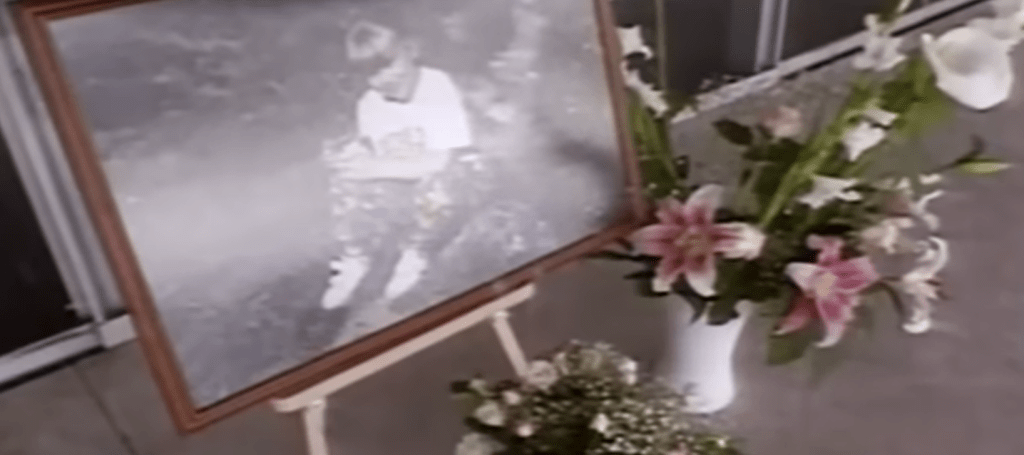
Michel Sydor’s trial begins on June 14, 1995, at the Annecy Assize Court. Emotions are still running high in the region, and many locals make the trip to attend. A large photo of Jessica is placed in front of the courthouse. Michel is calm and true to form, blaming the justice system for his actions and even saying, “You should have kept me in prison and I wouldn’t have committed this murder.”
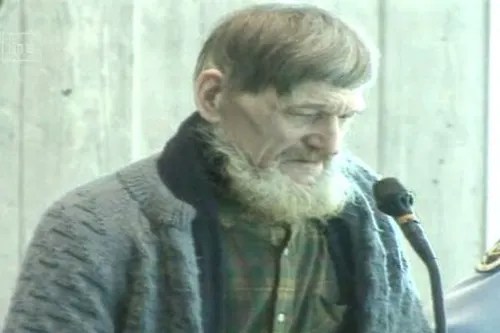
As the story of Jessica’s death, which lasted about 30 minutes, is recounted, Serge Blanc loses his temper and throws a chair at Michel. Unfortunately, the chair misses its target because a police officer intervenes.
On June 15, after less than an hour of deliberation, Michel is sentenced to life imprisonment with a minimum term of 30 years and transferred to Ensisheim Central Prison, where the worst killers and rapists are held (Guy Georges, Jonathann Daval, Pierre Bodein, Francis Heaulme, etc.). Maître Rimondi later stated: “I defended the worst of criminals for the worst of crimes.” One wonders why Michel did not receive a life sentence without parole. Perhaps it was expected that he would die before the end of his minimum sentence. If I were in the judges’ shoes, I would not have taken that risk.
In March 2001, Jessica’s parents take part in a large silent march organized in Paris to protest against the laxity of the justice system towards pedophiles. This march brought together many families of victims, including those of Émile Louis‘ victims.
On this occasion, Jessica’s parents speak out. Serge, who was a school bus driver, had to change jobs. “At every stop, I saw the image of my daughter getting on the bus. I couldn’t take it anymore.” Marie-Claude also changed jobs and now works in a retirement home because she can no longer bear to see children. Jessica’s older brother is also suffering from trauma. The family still feels incomplete, to the point that they no longer go on vacation.
In 2012, Michel requests release on medical grounds. At 82 years old, he has heart problems and urinary incontinence. This does not move Jessica’s family or the Savoyards (or me), who have not forgotten why he is locked up. A petition to keep him in prison gathers many signatures, and experts are unanimous in their assessment of Michel’s dangerousness, even at his age. On July 11, 2012, the Colmar Sentence Enforcement Court rejects the request but proposes transferring Michel to a suitable facility. Michel refuses and appeals, but his appeal is dismissed on December 11.
After that, he finally decides to leave the world alone, and dies on November 1, 2014, at the age of 85.
Even today, Jessica’s parents are still fighting against physical and sexual violence against children.
As for the mandatory life sentence that Michel surprisingly escaped, it is still in effect today. Eleven people have received this sentence so far, including Pierre Bodein, Michel Fourniret, Salah Abdeslam, and Dahbia Benkired.
That’s it for today! Let me know what you think about this case in the comments, or on Reddit / Tumblr / Bluesky / Threads / Instagram / Mastodon / Facebook! I hope you find some money on the ground, and I’ll see you next time !

Laisser un commentaire