
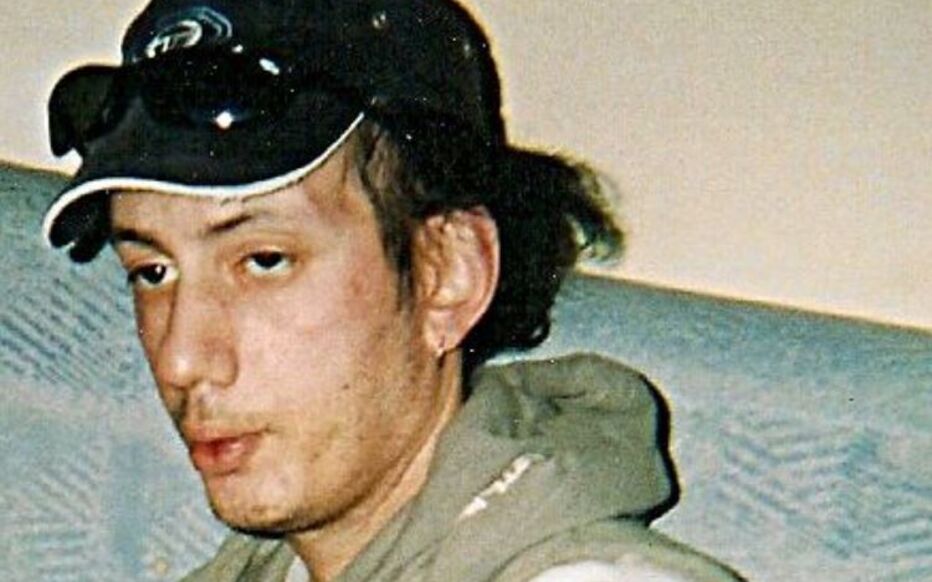
Hello everyone, I hope you’re all doing well.
The case I’m about to tell you about traumatized a community and went unsolved for 22 long years. Two families were betrayed and shattered in the worst possible way by a man who took perversion to a rarely seen level.
Warning: this case involves child abuse and murder, so if you don’t feel up to reading it, go watch a video of kittens—that’s totally fine. I’ll even put one right here.
If you’re ready, here is the Georges Pouille case.
A man troubled from birth
Georges Pouille is born in La Tronche, near Grenoble, on May 16, 1975. He is the result of a rape committed by a man named Mr. Dos Santos, a Portuguese national who has since returned to his homeland, though Georges will not learn this until much later.
His stepfather, Mr. Pouille, agrees to raise him as his son, and the family moves to Voreppe, another small town near Grenoble. Georges thus grows up with his mother, his stepfather, and the two children born of their union. He feels neglected compared to these two other children, who are raised more or less normally, while he is beaten and sometimes has to sleep in the doghouse.
Unfortunately, this psychological and environmental distress is compounded by physical distress. Georges Pouille suffers from Steinert’s disease. This genetic disorder affects one in 8,000 people in France and impacts the muscles and organs. The congenital form, from which Georges suffers, is characterized by muscle hypotonia, respiratory problems, and mental retardation.
Rough start. Another challenge arises during his teenage years. At age 13, Georges Pouille begins using drugs, particularly marijuana and cocaine (who’s the jerk who sold that to a 13-year-old?). His addiction causes problems at home, and his parents deal with these issues in the worst possible way, regularly kicking him out.
As is often the case, things aren’t any better at school. He struggles to keep up with his classes, becomes increasingly violent, and sexually harasses his classmates. His behavior eventually becomes a cause for concern, and he is briefly placed in a residential facility.
As an adult, he unsurprisingly struggles to find his place in the workforce. He drifts from one odd job to another without much stability. Despite everything, he manages to find love and moves in with his partner in 2004. The couple has a son in 2009 and the family, still living in Voreppe, faces financial instability and struggles with Georges’s addiction, which gets him arrested for driving under the influence of drugs at that time.
At that time, if you asked the residents of his neighborhood, you would hear that Georges is a sick man with many problems but who is kind and doesn’t cause trouble. But that’s not true. What I haven’t mentioned is that by the time his son is born, Georges has already killed twice.
Sarah

Sarah Syad was an ordinary 6-year-old girl who lived with her family in Voreppe. On April 16, 1991, she was playing in a playground near her home. It was the end of Ramadan, and her family had gone to visit relatives, leaving the little girl with her 16-year-old brother. He lost sight of her for a few moments, and unfortunately, that was enough. Sarah vanished, disappearing without a trace. The alarm was raised immediately, and everyone began searching for Sarah: family, neighbors, police, firefighters… But it was already too late. Her body was found the next day less than a kilometer from her home in a small grove, hastily hidden by branches. It showed signs of strangulation and sexual assault. A fingerprint was found on a pack of tissues, and biological traces were collected from the girl’s clothing, but unfortunately forensic science was not as advanced as it is today, so these clues could not be immediately analyzed. Despite this, investigators questioned and collected samples from several hundred residents of Voreppe, including members of Sarah’s family. However, the majority of those summoned were adults, whereas Georges Pouille was only 15 years old.
Saïda

November 24, 1996. Saïda Berch was 10 years old. Her mother had gone to the consulate in Grenoble, and she was being looked after by her brothers and sisters. She was walking down the street to go play after asking for permission, and she was seen on the street with a young man on a bicycle. After that, she was never seen again. Her mother returned home at 5 p.m. and immediately became worried when she didn’t see her. The whole family began searching for her, without success, and the police were notified around 10 p.m. A criminal investigation was opened the very next day, but once again, it was already too late. Her body was found early the following morning near a canal. She had also been strangled, possibly with her sweater, which was found tied around her neck. However, unlike Sarah, her body showed no signs of sexual assault. The investigators kept the sweater, and fingerprints were collected, but this did not advance the investigation any further.
This time, more than 500 people were questioned in an effort to find the young man on the bicycle, but to no avail. Georges was among those interviewed this time, but despite the fact that he owned a bicycle, he provided an alibi, and when his photo was shown to witnesses, they did not recognize him. The investigators therefore let him go, and the case was dismissed in September 1999.
The new investigation
Fortunately, Sarah and Saïda’s families did not give up, and in 2006, the two murders were linked due to their similarities.
In 2008, they were added to the case known as the “Missing children of Isère.” This case involves a series of child disappearances that occurred in the same area between 1980 and 1996. The investigations were taken over by the “Mineurs 38” unit, the first of its kind, created specifically for this case. The unit summoned the individuals who had been interviewed at the time, but uncovered no new evidence.
And while Georges gets to raise his son, two families are stuck living without their little ones.

In March 2013, the evidence collected from the two crime scenes is sent for analysis, and the families’ anguish is finally put to rest: the culprit is their friend, Georges Pouille. Indeed, he is a neighbor of the Syad family and a friend of the Berch family.
He is arrested at his home on the morning of July 23, 2013. While in custody, he confesses to Sarah’s murder but claims it was an accident. He reportedly took the girl into the woods, but panicked at the thought of being seen alone with a little girl, so he pushed her and she fell. He then allegedly masturbated over her unconscious body, and only after finishing did he check her pulse and realize she was dead. A moment of madness that went wrong, according to him.
What he says makes no sense. He panicked at the thought of being seen alone with a little girl, but didn’t panic at the thought of being seen masturbating over her body? Furthermore, as a reminder, Sarah didn’t die from a blow to the head, she was strangled. This isn’t just a lie anymore. It’s a total joke, and if I’d been the investigator facing him, I would’ve taken it personally.
Anyway. Regarding Saïda’s murder, Georges completely denies the charge. He explains that he ran into her while he was out riding his bike. The girl then asked him if she could take the bike for a spin; he agreed, but she kept following him even after she gave the bike back. This annoyed him, so he hit her (because, according to him, that’s a perfectly normal reaction). However, he claims the girl did not die from his blows. According to him, she was unconscious but still alive when he left her after gently tying her sweater around her neck. Of course, that must be it, yes.
He is indicted on July 25 and placed in detention in the medical wing of the Corbas prison.
Sarah and Saïda’s families are devastated and in shock, and are unfortunately directing their grief wherever they can. Christelle and her son receive death threats, and on the night of September 25, Georges’s mother and brother are beaten up by two of Sarah’s sisters who ran into them on the street. On October 25, they are sentenced to 15 months of suspended prison time and barred from contacting the Pouille family for this assault.
It is easy to judge the families’ reaction, but when one sees the extent of the perversion they have been subjected to, it is easier to understand this loss of control. Sarah’s mother babysat Georges’s son without suspecting that he had killed her daughter, and certain members of the Berch family went on vacation with him. Who could judge their reaction to this kind of betrayal?
Please note that I’m not saying that Georges’s family deserved to be attacked; I’m simply saying that Sarah and Saïda’s families aren’t monsters, but people who are hurting, deeply.
While he’s in pretrial detention, investigators try to determine whether Georges committed other murders in the area between Sarah and Saïda’s murders. After all, it’s unlikely that a man who kills so easily and impulsively could have held back for five years. Unfortunately, there are many unsolved cases in the area, and it’s impossible to establish a connection. All we know is that the deterioration of Georges’s health most likely prevented him from committing another murder after Saïda’s.
The trials
On March 9, 2016, the trial for the murder of Saïda Berch begins at the Grenoble Assize Court. Georges is frail, but that is not why he stands out. He refuses to answer questions, even the most basic ones. And when he speaks on the second day of the trial, it is to repeat that he is innocent, that he simply knocked the girl unconscious because she was annoying him by following him, that she was alive when he left. He also accuses the police of pressuring him, and he calls one of the investigators an asshole. Between bursts of insults, he asks to see his son, whom he hasn’t seen in three years. Finally, when asked what he thinks of the person who killed Saïda, he replies, “If someone had done that to my kid, I would have killed them.”
His mother testifies on the stand and admits to the abuse. It is there that she also reveals that Georges was born as a result of rape. He learns this at the same time as everyone else, and also learns that when she found out she was pregnant with him, she tried to have an abortion.
The experts acknowledge that his judgment was slightly impaired due to his illness, and the verdict is adjusted accordingly. That’s how on March 11, he is sentenced to 30 years in prison. Despite the judges’ leniency, he feels dissatisfied with the verdict and appeals, but it is a gamble he looses. The appeals court doesn’t accept the diminished discernment argument, and sentences him to life imprisonment.
On May 12, 2016, his trial for the murder of Sarah Syad begins at the juvenile court in Grenoble. Since the murder was committed when he was 15, he is tried as a minor. On the second day, the trial is interrupted when a lawyer faints, and it resumes on July 12.
During the trial, despite Georges’s mental disability, an expert describes him as a psychopath capable of committing the unthinkable at the slightest provocation. In the end, Georges is sentenced to 13 years in prison.
Throughout both trials, he remained impassive in the presence of his victims’ families—people who had considered him a friend and whom he betrayed in the worst possible way. His only regret seems to be going to prison and being separated from his son. How ironic for a man who took two children from their parents.
Georges Pouille remains in prison today but plans to apply for early release on grounds of health issues. He keeps to himself and keeps a low profile.
The murders of Sarah and Saïda are two of only three officially solved cases in the “Missing children of Isère” case.
Let me know what you think about this case in the comments, or on Reddit / Tumblr / Bluesky / Threads / Instagram / Mastodon / Facebook! I hope you find some money on the ground today, and I’ll see you next time !
Leave a Reply